What Are Healthcare Underpayments? A Complete Guide for Revenue Cycle Teams


What are healthcare underpayments?
Healthcare underpayments occur when an insurance payer reimburses a provider less than the amount they were contractually obligated to pay for a covered service.
Unlike denials, underpayments are often much harder to identify. The claim may be processed correctly, paid on time, and marked as complete. Unless someone compares the payment against the expected contracted reimbursement, the missing revenue may never be discovered.
For many provider organizations, underpayments represent one of the largest sources of hidden revenue leakage.
Key takeaways
- A healthcare underpayment is when a payer reimburses less than the contracted allowed amount.
- Underpayments are different from claim denials because the claim is paid, just not in full.
- Common causes include contract misconfigurations, fee schedule errors, coding issues, payer processing mistakes, and systematic reimbursement changes.
- Most organizations only audit a small sample of paid claims, allowing many underpayments to go unnoticed.
- AI-powered revenue intelligence can continuously monitor payments and identify reimbursement variances automatically.
What is considered an underpayment in healthcare?
A healthcare underpayment occurs whenever the actual reimbursement is lower than the amount specified in the payer contract.
For example:
- Contracted reimbursement: $425
- Amount paid by payer: $387
- Underpayment: $38
That $38 may seem insignificant on a single claim. Across thousands of claims each month, however, small variances can add up to hundreds of thousands or even millions of dollars in lost revenue. This is why many revenue cycle leaders treat underpayment management as a core component of revenue integrity.
Healthcare underpayments vs. claim denials
Although both reduce reimbursement, underpayments and denials require very different workflows.
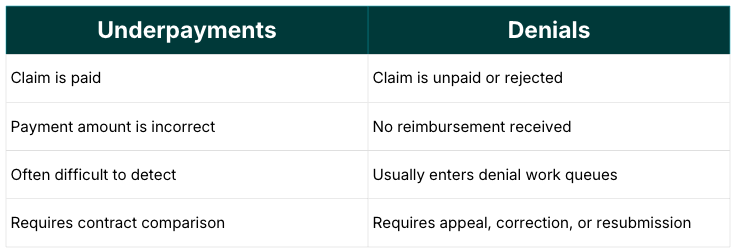
Because underpaid claims appear "resolved" inside many billing systems, they often receive much less attention than denials.
Why do healthcare underpayments happen?
There isn't a single cause. Most organizations experience underpayments from several sources simultaneously.
1. Contract pricing errors
Payer contracts are complex and frequently updated. If reimbursement schedules are loaded incorrectly or contract terms change, payments may not match negotiated rates.
2. Fee schedule discrepancies
Incorrect allowable schedules or outdated reimbursement tables can produce systematic payment variances across thousands of claims.
3. Coding differences
Changes to CPT coding, modifiers, or reimbursement logic can affect payment amounts even when the claim itself is accepted.
4. Payer processing mistakes
Claims processing systems occasionally apply incorrect payment methodologies, resulting in lower reimbursement than contracted.
5. Systematic payer behavior
Sometimes organizations discover recurring reimbursement patterns affecting specific CPT codes, specialties, or payer plans. These systematic issues often continue for months before being identified.
Why are underpayments difficult to detect?
Traditional denial management workflows are designed to identify unpaid claims.
Underpayments are different because the claim looks complete.
Many organizations rely on periodic audits or manual spreadsheet reviews to compare payments against contracts. Unfortunately, this approach has several limitations:
- Only a small percentage of claims are reviewed.
- Reviews often happen months after payment.
- Contract terms may be difficult to interpret consistently.
- Small variances are frequently overlooked.
- Teams spend significant time calculating expected reimbursement manually.
As claim volumes grow, manual review becomes increasingly impractical.
How healthcare organizations identify underpayments
Most organizations use one or more of these approaches.
Manual contract audits
Revenue integrity teams compare paid claims against payer contracts to identify reimbursement differences. While accurate, this approach is labor intensive and difficult to scale.
Allowable schedule validation
Some organizations maintain expected reimbursement schedules and compare payments against those benchmarks. This improves consistency but still requires ongoing maintenance.
Revenue intelligence platforms
Modern revenue intelligence solutions automate payment comparisons across every processed claim. Instead of reviewing small samples, organizations can continuously monitor reimbursement patterns, identify payer trends, and prioritize the highest-value recovery opportunities.
Example of a healthcare underpayment
Imagine an orthopedic practice submits 2,000 claims each month to a commercial payer.
After comparing payments against the contract, the revenue integrity team discovers the payer consistently reimbursed $22 less than the contracted amount for one frequently billed CPT code.
The issue affected 850 claims over six months.
Although each claim was only underpaid by $22, the total lost revenue exceeded $18,000 before anyone noticed.
This type of systematic reimbursement variance is common because individual claims rarely appear unusual.
Best practices for preventing healthcare underpayments
Leading revenue cycle organizations typically combine several strategies.
- Maintain accurate payer contracts and allowable schedules.
- Regularly validate fee schedules after contract updates.
- Monitor reimbursement trends by payer and CPT code.
- Prioritize high-value reimbursement variances.
- Automate payment variance detection whenever possible.
- Review recurring payer patterns before they become long-term revenue leakage.
Rather than waiting for periodic audits, many organizations are moving toward continuous reimbursement monitoring.
Frequently asked questions
What is a healthcare underpayment?
A healthcare underpayment occurs when a payer reimburses less than the contracted amount for a covered healthcare service.
How are underpayments different from denials?
A denied claim receives no payment or requires additional action before payment. An underpaid claim has already been paid, but the reimbursement amount is lower than expected.
What causes payer underpayments?
Common causes include contract errors, fee schedule discrepancies, coding differences, payer processing mistakes, and recurring reimbursement patterns affecting specific claims.
How do providers recover underpayments?
Organizations typically compare paid claims against payer contracts, identify reimbursement variances, and submit payment disputes or recovery requests when appropriate.
Can underpayments be automated?
Yes. Many healthcare organizations use revenue intelligence platforms that automatically compare payments against expected reimbursement and surface potential underpayments for review.
Finding underpayments before they become revenue leakage
Underpayments rarely generate alerts, enter work queues, or appear in standard denial reports. That makes them one of the easiest forms of revenue leakage to miss.
As payer contracts become more complex and claim volumes continue to grow, manual audits alone often aren't enough. Continuous monitoring allows revenue cycle teams to identify reimbursement variances earlier, understand payer trends, and focus recovery efforts where they will have the greatest financial impact.
If your organization is already managing denials effectively, improving visibility into underpayments is often the next opportunity to strengthen overall revenue integrity.
See how Adonis can help your team detect and act on underpayments. Get a demo.