What Is Payer Downcoding? How Healthcare Organizations Can Detect and Prevent Revenue Loss

Quick answer
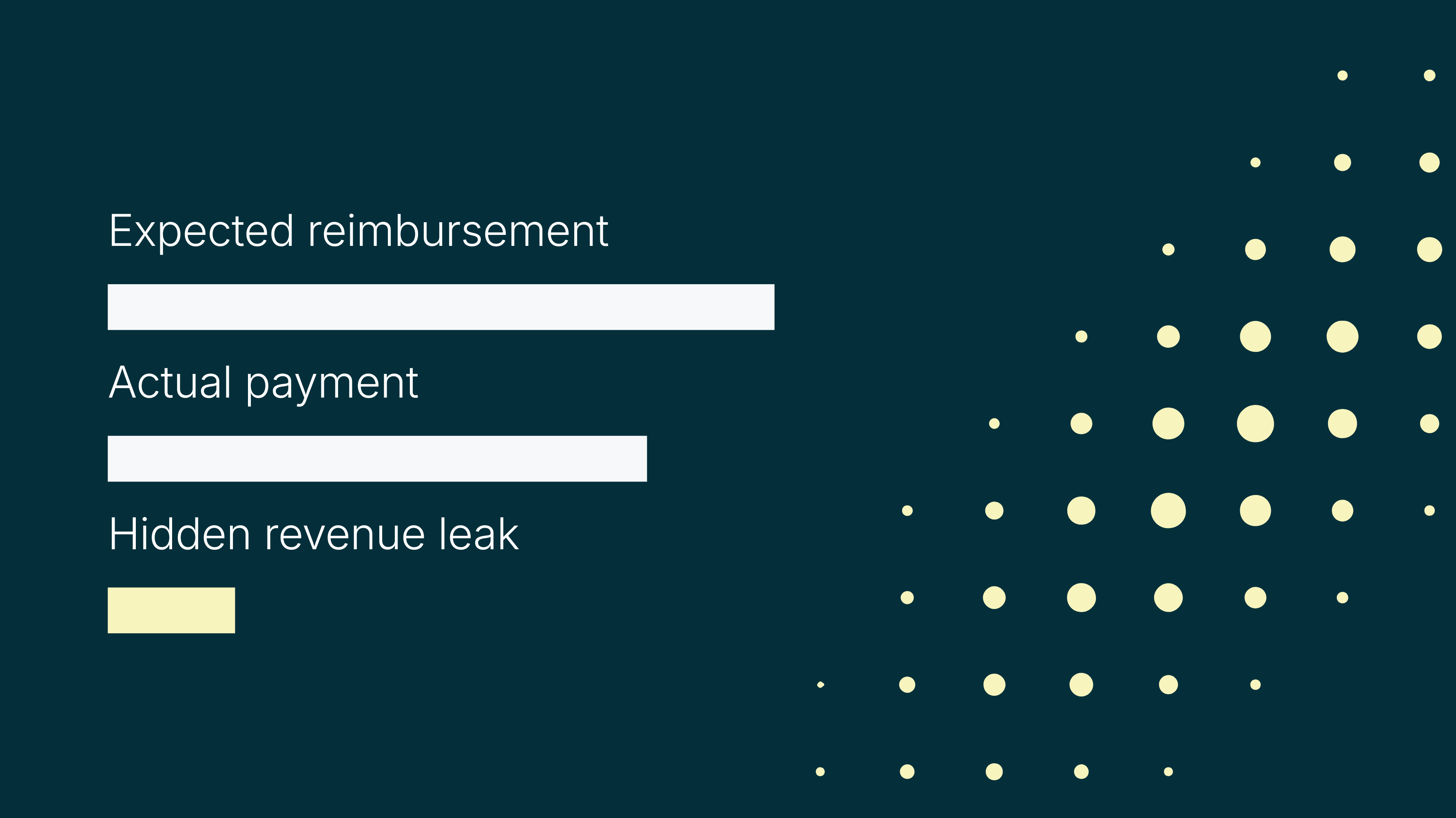
Payer downcoding occurs when an insurer reimburses a healthcare claim at a lower level than expected based on the submitted claim and the payer's reimbursement policies. While some downcoding may be appropriate, systematic or unsupported downcoding can lead to significant revenue loss if healthcare organizations lack visibility into reimbursement patterns.
Key takeaways
- Downcoding differs from a denial because the claim is typically paid, just at a lower reimbursement amount.
- Downcoding is one type of healthcare underpayment, but not all underpayments are caused by downcoding.
- Small reimbursement differences can compound into significant revenue loss across thousands of claims.
- Detecting systematic downcoding requires analyzing payer reimbursement patterns, not just individual claims.
- AI can help identify reimbursement trends that are difficult to spot through manual review.
Payer downcoding is one of the easiest ways revenue can leak out of a healthcare organization without triggering the usual alarm bells. Unlike a denial, a downcoded claim is often still paid. The problem is that it is reimbursed at a lower level than expected. That makes it harder to spot, harder to investigate, and easy to dismiss as a one-off variance. But when the same reimbursement pattern repeats across thousands of claims, the financial impact can become material.
Healthcare organizations don't lose revenue simply because downcoding exists. They lose revenue because systematic reimbursement patterns are difficult to detect at scale. That is why more revenue cycle and revenue integrity teams are beginning to treat downcoding as a distinct reimbursement issue rather than folding it into broader denial management.
What is downcoding?
Downcoding occurs when a payer reduces reimbursement by assigning a lower level of service, changing the billed code, or otherwise paying less than a provider reasonably expected based on the submitted claim and applicable reimbursement policies.
In practice, that can mean:
- A higher-acuity visit is reimbursed at a lower level of service.
- A billed code is changed to one with lower reimbursement.
- The claim is paid, but the reimbursement does not align with the expected payment.
This is what makes downcoding operationally challenging. The claim may appear resolved because it was paid and posted. But the reimbursement may still be lower than expected. That distinction matters. Traditional denial workflows are designed to react to claims that stop moving through the revenue cycle. Downcoded claims often continue through payment, which means reimbursement issues can remain hidden unless organizations are actively monitoring payment patterns.
Is downcoding legal?
Downcoding itself is not automatically inappropriate or unlawful.
Payers routinely review claims to determine whether the billed services meet their reimbursement policies and documentation requirements. If a payer concludes that a claim does not meet those requirements, it may reimburse the claim at a lower level.
The more important question for healthcare organizations is not simply whether downcoding is permitted. It is whether reimbursement adjustments are accurate, consistently applied, and supported by applicable policies and documentation.
Organizations should ask:
- Is the payer applying reimbursement changes consistently?
- Do the adjustments align with contract terms, coding guidance, and documentation?
- Are the same reimbursement patterns appearing across providers, facilities, specialties, or CPT codes?
- Is the organization appealing and recovering revenue when payer adjustments are not warranted?
Some downcoding may be appropriate. Systematic, unsupported, or unchallenged downcoding is where revenue risk begins to grow.
Why do payers downcode claims?
There is no single reason organizations experience downcoding. Several factors can contribute.
In some cases, payers determine that documentation or coding does not support the billed level of service. In others, reimbursement may reflect payer-specific policies, automated editing systems, medical necessity determinations, or proprietary reimbursement methodologies.
Regardless of the reason, many provider organizations struggle to identify when isolated reimbursement adjustments become a repeatable pattern.
Many revenue cycle workflows remain optimized around denials rather than reimbursement variance. If a claim is paid, teams may not review it with the same urgency they would apply to a denied claim, even when the payment amount differs from expectations.
Fragmented visibility also contributes to the challenge. Revenue cycle, coding, managed care, and revenue integrity teams may each see part of the problem without having a complete view of reimbursement trends across the organization.
How is downcoding different from underpayments?
The two are closely related, but they are not the same.
An underpayment is the broader category. It simply means the organization received less reimbursement than expected.
Downcoding is one type of underpayment. Specifically, it occurs when lower reimbursement results from the payer treating the claim as though it should have been billed or reimbursed at a lower level.
A simple way to think about it:
- Underpayment is the broader reimbursement issue.
- Downcoding is one mechanism that can cause an underpayment.
Other underpayments may result from fee schedule discrepancies, contract misapplication, carve-out issues, coordination of benefits errors, or payment processing mistakes. Understanding the difference matters because the investigation and resolution process may vary depending on the underlying cause.
How do you know if downcoding is systematic?
Most organizations do not identify systematic downcoding from a single claim. They identify it by recognizing patterns across many claims.
Common warning signs include:
- The same payer consistently reimburses certain services below expected levels.
- Similar reimbursement patterns appear across multiple providers, locations, or specialties.
- Paid claims consistently fall below expected reimbursement while denial rates remain relatively stable.
- Small reimbursement differences accumulate into meaningful financial impact over time.
- The issue does not appear in traditional denial reporting or A/R work queues.
This is exactly what makes downcoding easy to underestimate. The claims are paid, posted, and often closed without drawing attention to the reimbursement variance.
ApolloMD provides a good example. As outlined in this case study, the organization identified $46.6 million in downcoded payments since 2023 and $34.2 million in outstanding balances after gaining greater visibility into reimbursement patterns. What initially appeared to be isolated payment differences became a measurable revenue integrity opportunity once the broader trend was identified.
In other words, systematic downcoding typically becomes visible only when organizations move beyond reviewing individual claims and begin analyzing reimbursement patterns across large volumes of payer activity.
How can AI detect downcoding?
Downcoding is fundamentally a pattern-recognition problem.
Most organizations do not have the resources to manually compare billed, expected, and actual reimbursement across every payer, provider, CPT code, and facility. AI can help identify the claims and reimbursement trends most likely to require attention.
In practice, AI can help organizations:
- Compare expected and actual reimbursement across large claim volumes.
- Detect unusual reimbursement patterns by payer, CPT code, provider, or service line.
- Identify recurring payment variances that would be difficult to detect manually.
- Prioritize the highest-value recovery opportunities.
- Support faster investigation, appeals, and reimbursement analysis.
ApolloMD's story illustrates this approach. The organization reported identifying $46.6 million in downcoded payments while also reducing Optum VA denials by 67% and saving more than 2,000 hours through AI-supported workflows.
The goal is not to replace revenue cycle expertise. It is to help teams focus their time on reimbursement patterns that would otherwise remain hidden.
What healthcare organizations should do next
If your organization suspects downcoding may be affecting reimbursement, the first step is not a large-scale manual audit. It is creating better visibility into where reimbursement differs from expectations and determining whether those differences represent isolated events or repeatable patterns.
A practical starting point includes:
- Establish expected reimbursement benchmarks by payer, contract, and code where possible.
- Monitor reimbursement variance separately from denial reporting.
- Review paid claims for recurring reimbursement patterns rather than isolated exceptions.
- Align revenue cycle, coding, managed care, and revenue integrity teams around investigation and follow-up.
- Prioritize high-volume or high-dollar reimbursement trends first.
- Develop a repeatable process for appeals, reconsideration, and revenue recovery.
That operational discipline helps organizations move from simply noticing reimbursement differences to understanding why they occur and whether they warrant action.
As Tennille Lizarraga of ApolloMD shared:
"Partnering with Adonis has transformed how we manage revenue cycle operations. Their technology delivers real-time alerts and visibility into payer anomalies and accounts receivable, empowering us to automate workflows and prevent denials. We're continuing to expand our collaboration with Adonis to drive greater efficiency and uncover new opportunities to maximize collections."
Frequently asked questions
What is payer downcoding?
Payer downcoding occurs when an insurer reimburses a healthcare claim at a lower level than expected based on the submitted claim and the payer's reimbursement policies.
Is downcoding the same as an underpayment?
No. Downcoding is one type of underpayment, but underpayments can also result from contract errors, fee schedule issues, payment processing mistakes, or other reimbursement discrepancies.
Why do insurance companies downcode claims?
Downcoding may occur because of payer reimbursement policies, documentation reviews, medical necessity determinations, automated editing systems, or other adjudication processes.
Can providers appeal downcoded claims?
Yes. If an organization believes a reimbursement adjustment is unsupported by documentation, contract terms, or payer policy, it may pursue reconsideration or appeal through the payer's established process.
How do healthcare organizations detect systematic downcoding?
Organizations typically identify systematic downcoding by analyzing reimbursement patterns across payers, providers, CPT codes, and facilities rather than reviewing claims individually.
Can AI identify payer downcoding?
AI can help detect reimbursement patterns, identify recurring variances, and prioritize claims that warrant further investigation, making systematic downcoding easier to identify at scale.
Downcoding is a visibility problem before it becomes a recovery problem
One of the biggest assumptions in revenue cycle management is that if a claim was paid, it was paid correctly.
That assumption can break down when reimbursement patterns change faster than reporting, workflows, and staffing models can adapt.
Downcoding is more than a coding nuance or an isolated payment issue. When it occurs repeatedly, it becomes a revenue integrity challenge with meaningful financial consequences.
Organizations that respond effectively are those that can identify reimbursement patterns early, quantify their impact, and act before revenue loss becomes embedded in routine payment activity.
Learn how Adonis Intelligence is helping teams detect and combat downcoding. Get a demo today.